
Fair DAO Governance
Mitigating Voting Power Concentration
Team
Max Planck Institute for Software Systems
Role
Visiting Scholar
Duration
3 months (2025)
.png)
Challenge
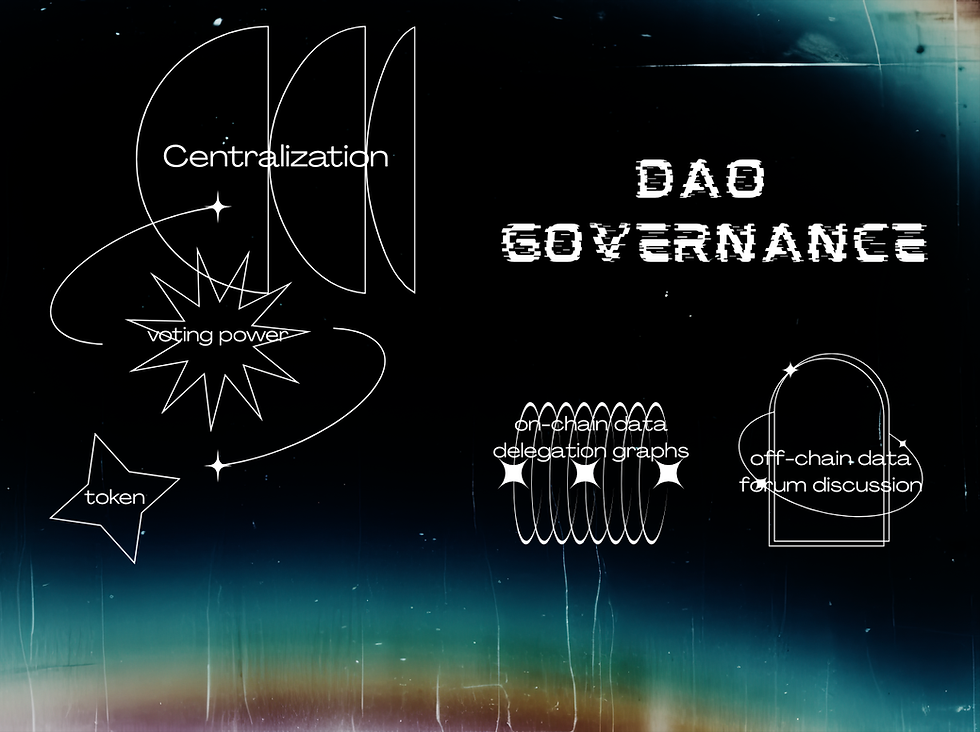
Governance tokens are highly concentrated in many DAOs, leaving most voting power in the hands of a few addresses. Delegation platforms like Tally usually sort delegates based on metrics such as their voting power or received delegations. The most prominent delegates rise to the top of lists and draw more delegators. This results in “rich-get-richer” dynamic, where already influential delegates accumulate more voting power. Consequently, a small group can significantly shape governance decisions, undermining decentralization of DAOs.

Solution
Proposed an interest-aligned delegation system, which recommends delegates whose interests align with those of the token holder and shifts from popularity-based to preference-based delegates selection.
Approach: Step 1 Multi-modal Analysis
Conducted a multi-modal analysis by mapping user identities across on-chain governance data and off-chain forum discussion data.
On-chain data: Deployed Ethereum and Arbitrum archive nodes and synchronized them with the respective blockchains.
Off-chain data: Scraped all proposals and their associated discussions threads from the governance forums of 14 DAOs.
Linked on-chain activity with off-chain discussions to infer user interests and interpret interest alignments.

Approach: Step 2 Voter Interest Extraction
Conducted a voting interest analysis based on data obtained through identity resolution.
Categorized governance proposals using a unified taxonomy of topics and importance levels.
Extracted key discussion topics from forum posts using LLM-based keyword analysis.
Constructed voter-level interest representations and applied embedding and clustering methods to identify groups of voters with similar interests.

Results
Voting power and token ownership are highly unequal across DAOs, with very high Gini coefficients.
Identified distinct clusters of voter interests (e.g., finance-driven, innovation-driven groups).
Delegations often do not match the interests expressed by token holders in governance discussions.